
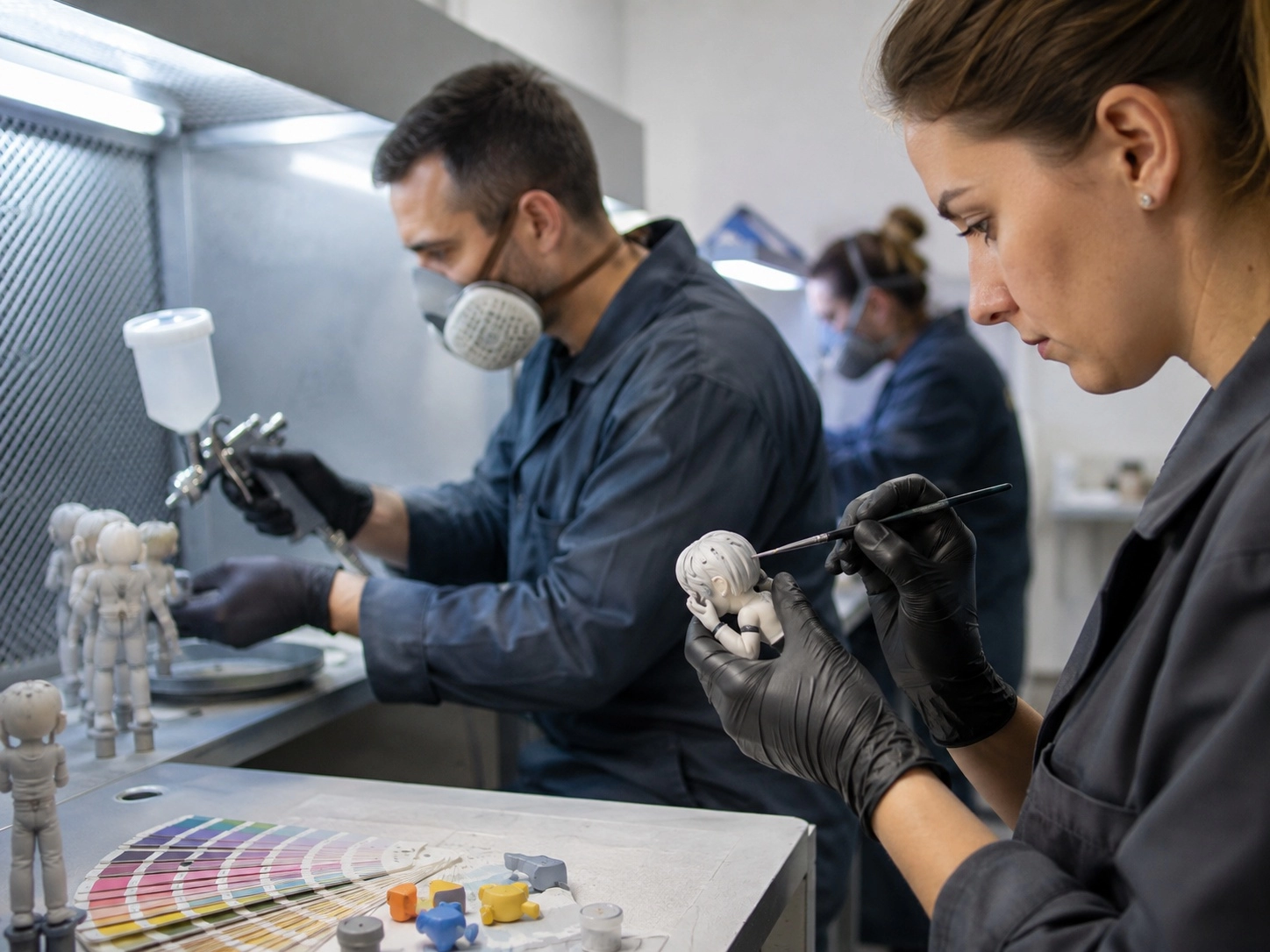
Two factories can cut identical molds, run the same resin and still ship figures that look like different products. The difference is colour. On a collectible figure, a two-point shift in a skin tone or a slightly milky clear part is the first thing a collector notices and the hardest defect to argue about after shipment. Longman controls this with a hand-painted colour sample process, Pantone-anchored targets and a ten-set bulk colour approval before mass production begins.
Why Colour Is the Least Forgiving Specification in Toy Manufacturing
Dimensional tolerances can be measured with calipers and printed on a drawing. Colour resists that treatment. It shifts with material, with surface finish, with part thickness and with lighting. Four mechanisms cause most colour failures:
- Resin interaction. The same pigment masterbatch produces a different result in ABS, PVC and vinyl because each polymer has its own base hue, opacity and light-scattering behaviour. A target mixed for vinyl will read wrong on an ABS part.
- Wall thickness. A translucent or semi-opaque colour changes with section thickness. A 1.5 mm hair strand and a 4 mm torso in the same colour will not match each other.
- Surface texture. Matte, gloss and textured finishes reflect light differently even when the underlying colour is identical, so adjacent parts with different finishes appear mismatched.
- Ink and paint viscosity. Pad-printed and sprayed layers change tone with film build. A slightly thicker coat darkens; a thinner coat lets the substrate through.
None of these can be resolved by a colour code alone. They have to be resolved on a physical sample, in the actual material, at the actual thickness.

Hand-Painted Colour Samples: The Reference That Actually Travels
Longman's colour approval begins with a hand-painted colour sample. A physical prototype is painted by hand to the approved artwork, then submitted for the customer's confirmation and signed approval. Hand-painting is used deliberately at this stage rather than going straight to production tooling, because it lets the painter resolve tone transitions, shading, weathering and edge detail by eye — the same way the finished production figure will ultimately be judged.
The colour sample becomes the project's master reference. It is not a rendering, not a digital swatch and not a photograph. It is a physical object that can be sent to a stakeholder in another country, held next to a licensed style guide, and compared under neutral light. When a dispute arises later in the program, this sample is the arbiter.
What the hand-painted sample locks in:
- Base colour values for every part, matched against the customer's Pantone or brand targets
- Shading and gradient placement on faces, hair, armour and clothing
- Finish assignment per part — gloss eyes, satin skin, matte fabric, metallic trim
- Clear and translucent part treatment, including tinted or smoked components
- Masking and edge definitions for pad-printed details
From Pantone Target to Production-Ready Paint and Ink
A Pantone reference is a starting point, not a formula. Converting it into a reproducible production colour means building a mixing standard that behaves consistently across every part, every fixture and every batch.
Longman's colour engineers build colour to a controlled recipe per material and per surface finish, then verify it on the actual production substrate. Critical steps include:
- Substrate-specific matching. Skin tones are matched on the specific resin used for the part, not on a lab panel of a different material.
- Thickness-adjusted targets. Thin cosmetic sections are matched to a slightly compensated value so the assembled figure reads correctly as a whole.
- Finish-consistent formulation. Matte, satin and gloss variants of the same colour are formulated together so adjacent parts agree.
- Spray and print alignment. Sprayed base coats and pad-printed details are matched as a set, so printed insignia sit correctly on their sprayed backgrounds.
- Batch records. Every mixing batch is recorded so that a reorder two years later reproduces the original, rather than approximating it.

Ten-Set Bulk Colour Approval: The Gate Before Mass Production
Once injection samples are approved, Longman prepares painting fixtures and pad-printing plates. Then comes the decisive step: ten sample sets are produced for final bulk colour confirmation. Only after those sets are approved does formal mass production scheduling begin.
Ten sets — not one — because a single good sample proves nothing about consistency. Producing ten sets exercises the actual production path: the fixtures, the spray passes, the ink plate pressure, the drying conditions. Reviewing ten sets side by side shows whether the process holds its colour across repeated cycles or drifts. If set three is a half-shade light or set seven shows ink spread, that is visible now, when it costs a fixture adjustment, instead of after ten thousand units.
Buyers reviewing a ten-set submission should compare:
- Colour consistency set to set, and against the signed hand-painted sample
- Shading and gradient placement on every set, not just the first
- Printed detail sharpness and registration across the run
- Finish consistency — no unintended gloss or flat spots
- Assembly fit between painted parts, since film build affects clearances
Where Colour Control Sits in the Program
Colour work is deliberately placed at two points in Longman's ten-stage workflow: a hand-painted colour sample and sign-off at stage four, and a ten-set bulk approval at stage nine, immediately before controlled mass production. The first establishes the target on a physical part. The second proves the production line can reproduce it.
Between those two gates sit mold engineering, trial molding and white-sample validation — all evaluated on unpainted parts, so that structural and dimensional problems are resolved independently of colour. Separating the two concerns keeps a colour question from stalling tooling, and keeps a tooling change from silently invalidating an approved colour.
For a buyer, the question worth asking is not "do you match Pantone" — everyone says yes. Ask instead: how many sets do you submit for final bulk colour approval, and what do I sign off on before that? A hand-painted sample plus a ten-set bulk submission gives you two documented checkpoints and a physical reference that survives the project.
Send your artwork, licensed style guide and colour targets to the Longman team to begin a colour-matched figure or collectible development review.