
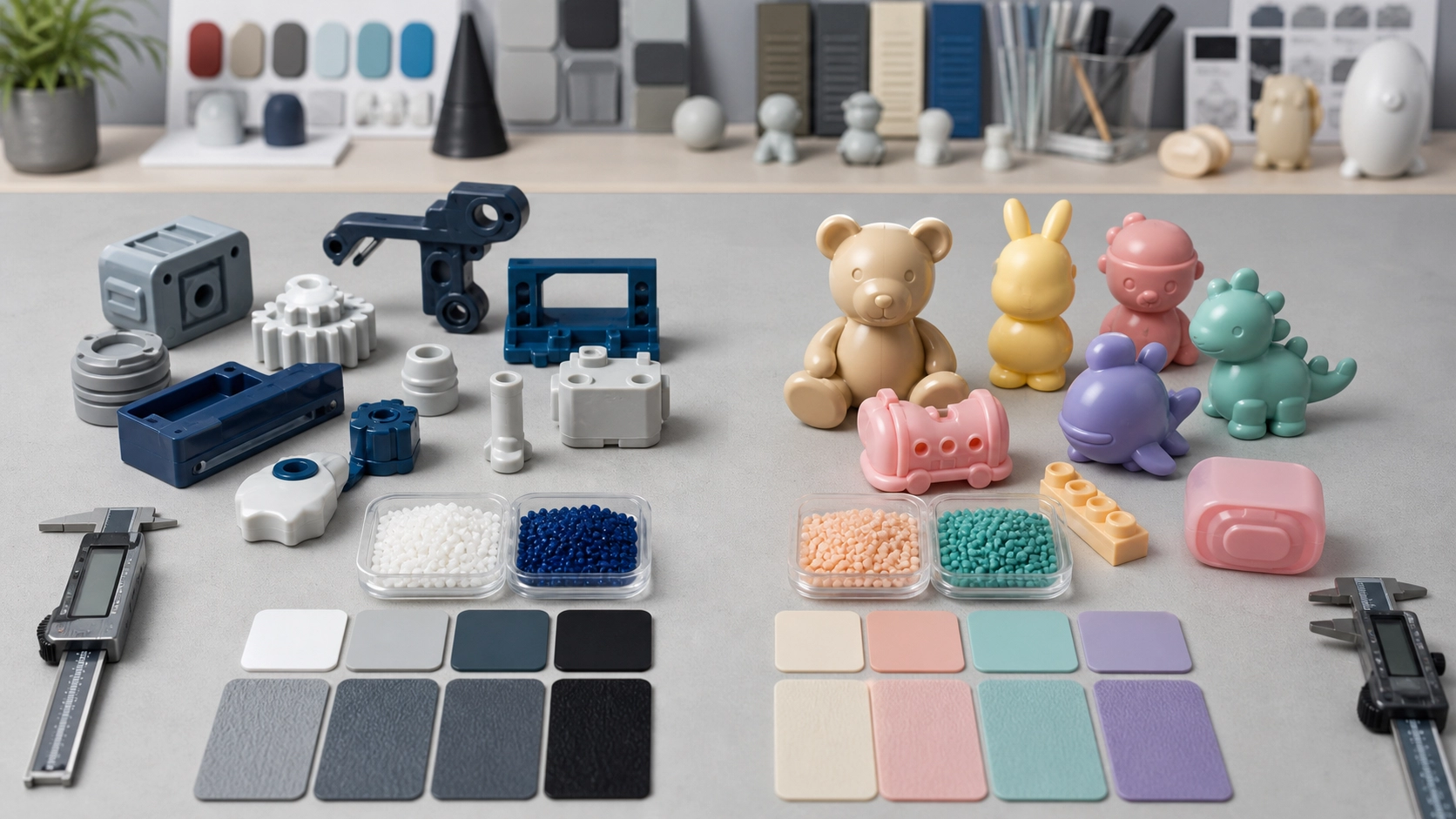
ABS and PVC are common material families in custom toy development, but they are not interchangeable. ABS is generally selected when a design needs rigidity, dimensional definition, or structural performance. PVC formulations can provide a wider range of flexibility and are often considered for molded figures, softer components, or products where hand feel is important. The best choice depends on part geometry, function, finish, assembly, target market, and the specific grade proposed for production.
A material name alone does not define final performance. Resin grade, additives, colorant, wall thickness, molding conditions, part design, and post-processing all affect the result. Project teams should compare representative production-intent samples and confirm applicable testing requirements rather than making decisions from a generic sample or a material label.
How ABS behaves in toy components
ABS is a rigid thermoplastic used in many molded consumer products. In toy projects, it can be suitable for shells, vehicles, model components, construction elements, internal supports, bases, and parts that rely on controlled fit. Its rigidity helps a part hold shape, while its molding behavior can support defined edges and detailed mechanical geometry when the part and tool are designed appropriately.
That same rigidity means a thin ABS feature may not bend repeatedly without stress. Snap fits, clips, hinge-like details, posts, and screw bosses need suitable geometry, radii, wall relationships, and assembly forces. Sharp internal corners or abrupt changes in section can concentrate stress. Engineers should review how a part will be assembled, dropped, handled, and loaded rather than assuming that a rigid material automatically makes every feature durable.
How PVC behaves in toy components
PVC can be formulated across a range of hardness levels. In custom figures and character-shaped products, softer formulations may support rounded forms, flexible appendages, or a tactile feel that would be difficult to achieve with a rigid resin. Different grades can also behave differently in molding, painting, bonding, odor, migration, and long-term storage, so the proposed production formulation matters.
Flexible material can reduce the risk of a thin feature feeling brittle, but it may also move, deform, or fit differently under load. Large flat areas, long unsupported shapes, tight mechanical interfaces, and very fine projections need careful evaluation. A soft part that looks accurate immediately after molding may respond to temperature, packing pressure, or storage orientation in ways that a rigid part does not.
Compare rigidity, flexibility, and dimensional control
The first question is what each component needs to do. A structural body that carries joints or aligns several parts may benefit from ABS. A decorative outer figure with a softer touch may be better suited to an appropriate PVC formulation. Some products combine materials: a rigid internal structure can support softer external components, or separate rigid accessories can accompany a flexible figure.
Mixed-material construction adds interfaces that must be tested. Designers need to consider tolerances, friction, chemical compatibility, bonding, mechanical retention, and how each material responds during assembly and storage. A fit that works in a digital model may become too loose or tight when production variation and material movement are introduced.
Evaluate detail and surface appearance
Both material families can reproduce detail, but the result depends on the grade, geometry, tool surface, molding process, and intended finish. ABS often supports crisp mechanical lines and controlled mating surfaces. PVC is frequently used for sculpted organic forms, but extremely fine details, deep undercuts, or thin projections may need adjustment for reliable molding and demolding.
Surface texture changes how color and detail are perceived. A polished surface may show reflections and flow-related variation, while a textured surface can soften highlights but complicate printed decoration. Texture depth, draft, parting lines, gates, and ejector locations should be reviewed as part of the visual design, not treated only as tooling details.
Plan decoration and color with the material
Molded color can reduce the amount of post-decoration, but many custom toys use spray painting, pad printing, transfers, decals, or hand-applied details. The coating system must be compatible with the chosen material and preparation method. Adhesion, flexibility, masking, cure conditions, abrasion, and color consistency should be evaluated on production-intent parts.
A finish that performs well on rigid ABS may not behave the same way on flexible PVC. If a decorated area bends, the coating needs to tolerate that movement. Plasticizers or surface conditions can affect coating and bonding behavior. Suppliers should identify the intended material grade and finishing process together, then confirm the combination through samples rather than relying on an unrelated past project.
Consider tooling and part design
Material choice influences draft, gate design, venting, shrinkage allowance, ejection, wall thickness, and cooling strategy. It can also influence whether a part is practical as one piece or should be separated. Deep recesses and undercuts may require slides, inserts, or a different part split. Flexible parts sometimes release from geometry that would lock a rigid part, but this should be reviewed deliberately because stretching during release can distort detail.
Tooling decisions should be based on the approved material family and grade. Changing material after tooling has advanced may affect fit, dimensions, surface appearance, and process settings. If alternatives must remain open, identify that requirement before the tool design is finalized.
Address assembly, use, and packaging
ABS parts may use screws, snaps, pins, welding, or adhesives depending on the design. PVC components may use mechanical retention, compatible bonding systems, or other assembly methods suited to the formulation. Every joining method should be evaluated for the actual loads and expected handling. Moving joints also require a balance between friction, wear, clearance, and assembly force.
Packaging conditions matter as well. Flexible parts may need support so they are not held out of shape, while hard surfaces may need separation to prevent rubbing or decoration damage. Temperature exposure, tray pressure, accessory placement, and carton orientation can reveal risks that are not obvious during an unpackaged sample review.
Use testing to confirm the decision
Material selection should connect to the intended age grading, product function, destination market, and applicable requirements. Chemical, mechanical, physical, and flammability evaluations may be relevant depending on the product and jurisdiction. The responsible project team should define the required testing with qualified specialists and laboratories. Material documentation can support the process, but the finished product and its accessible components may still require evaluation.
A practical comparison uses samples that match intended thickness, color, decoration, assembly, and packaging as closely as possible. Teams can then review appearance, fit, flex, drop behavior, surface durability, deformation, and other project-specific risks. Record the material designation and approved sample so the production baseline is unambiguous.
Conclusion
ABS is often a strong candidate for rigid, structural, or precision-oriented toy parts, while PVC can suit softer, sculpted, or flexible components. Neither is universally better. The correct decision comes from function, geometry, finish, assembly, packaging, and verified requirements. For an original custom toy project, discuss each component and its performance needs with an experienced OEM engineering team before finalizing materials or tooling.